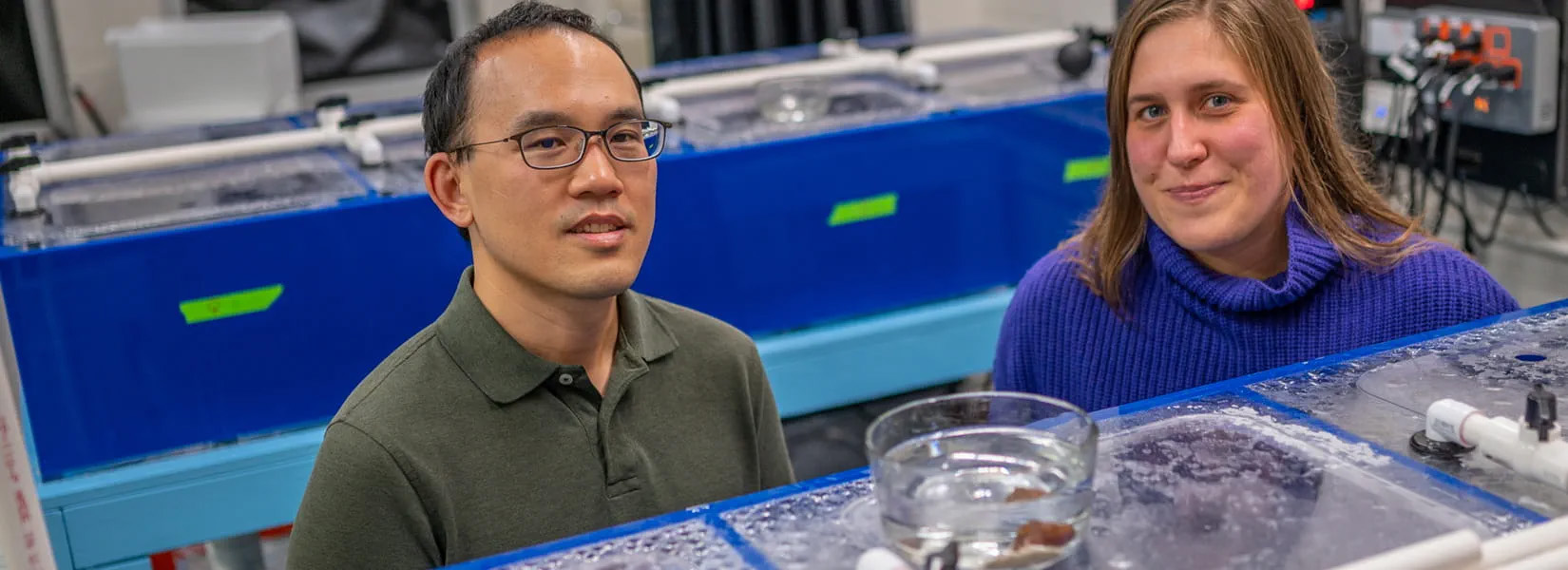
<?xml version="1.0" encoding="UTF-8"?><item href="/news/2022-10-how-teamwork-in-nature-and-the-lab-can-teach-us-about-climate-change.aspx" dsn="blogs"><homehero>true</homehero><unit>College of Natural Science,Integrative Biology</unit><pubDate>10/20/2022</pubDate><title>How teamwork, in nature and the lab, can teach us about climate change</title><description><p>Michigan State University and the University of California, Merced, are working to get a better handle on the huge problem of climate change with the help of some very small organisms. With $12.5 million from the National Science Foundation, MSU researchers Elizabeth Heath-Heckman and Kevin Liu are teaming up with UC Merced’s Michele Nishiguchi to launch an institute that focuses on a new angle in climate change.</p></description><author>Val Osowski</author><hero-image><img src="/_assets/images/news/2022/2022-10-how-teamwork-in-nature-and-the-lab-can-teach-us-about-climate-change.banner.jpg" alt="MSU Associate Professor Kevin Liu (left) and MSU Assistant Professor Elizabeth Heath-Heckman (right) stand in the Heath-Heckman Symbiosis Lab. Credit: Derrick L. Turner"/></hero-image><image><img src="/_assets/images/news/2022/preview.2022-10-how-teamwork-in-nature-and-the-lab-can-teach-us-about-climate-change.banner.jpg" alt="MSU Associate Professor Kevin Liu (left) and MSU Assistant Professor Elizabeth Heath-Heckman (right) stand in the Heath-Heckman Symbiosis Lab. Credit: Derrick L. Turner"/></image><tags><tag>climate change models</tag><tag>conservation</tag><tag>research</tag><tag>symbiotic relationships</tag></tags></item>