Why are Scientists Looking at 'Virtual Plants'?
What if a research question is too large, too complex, too dangerous, too small or too fleeting to be answered through experiments?
To tackle these questions, scientists can tap into supercomputers: precision-engineered machines with unparalleled computational power, emblazoned with names like Frontier or El Capitan.
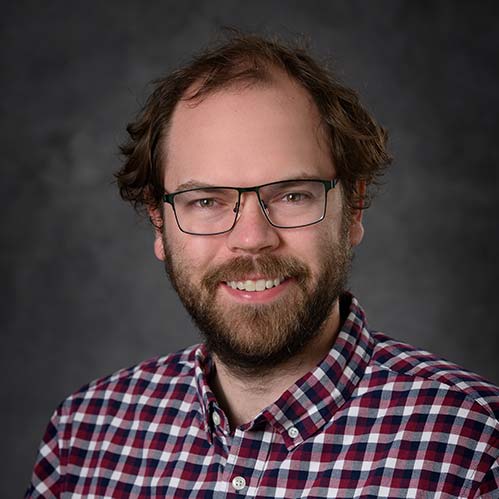
At MSU, Josh Vermaas, an associate professor in the Department of Biochemistry & Molecular Biology and the MSU-DOE Plant Research Laboratory, uses supercomputers to simulate living organisms. This computational power allows him to model the molecular machinery of plants and algae at a nanoscopic scale, as small as one-billionth of a meter.
We asked Vermaas how his lab is making the most of supercomputers, and why these machines, which Vermaas calls computational microscopes, are so adept at unlocking new frontiers in plant science — sometimes without a seed or shoot in sight.
Why are scientists interested in virtual plants?
In our lab, we test a lot of things that can’t be set up to test experimentally, which is to say we model things that are too small or which happen too quickly to study in real plants.
That’s why we use supercomputers. They work like computational microscopes and allow us to study things that are hard to see and often impossible to test otherwise.
For example, we’ve been looking at carboxysomes, which are compartments in plants’ cells that help improve the efficiency of photosynthesis. Carboxysomes, which look a bit like a 20-sided die, have these shells made of tightly laced proteins. The shell acts as a membrane that allows some select molecules to move through. They are really small, around 150 nanometers in diameter; you can't just put a probe on the inside, because then you just poke the hole in your shell. By using simulation instead, we can build those models and then ask, “Okay, where are the particles going?” without piercing the shell.
How do supercomputers make this research possible?
The basic concept behind most supercomputers is similar, but the reason why we have them—and specifically why the Department of Energy has the biggest supercomputers in the world—stems from the fact that we cannot experimentally test nuclear weapons. Instead, we need to theoretically test them. The same reason why simulation and computation are useful techniques for evaluating nuclear weapons is also why they're useful for plant science: because they show things that are hard to see and are impossible to test otherwise.
Supercomputers are great at running simulations, which are essentially complex—and frankly boring—math, applied repeatedly. When we run simulations, we’re trying to figure out how a very small, very quick process unfolds by capturing changes, each at a single point in time, and then stitching them together. Repeat this a few billion times, and now you can see how the simulation evolves.
But because of how supercomputers are connected, we can distribute that math to run
millions of calculations at once, dramatically speeding up simulations. So, instead
of one person drawing hundreds of frames, it’s like a team of animators working together,
each one drawing a frame.
That’s what supercomputers do; they allow us to run a lot of intensive calculations
very quickly and then stitch them together.
How powerful are these computers when they work together?
Let’s say we want to simulate how a group of one million atoms behave in the membranes of a plant cell for an entire microsecond. Using one graphics processing unit, or GPU, like on a powerful desktop computer, we would be able to simulate about four or five nanoseconds a day. In that case, it would take 200 days to achieve our goal. Frontier has nearly 80,000 GPUs. If we could efficiently use the entire machine, it would take less than 4 minutes.
But our simulations don't just run on one GPU. They can scale up to run across multiple units working together; so, we can use strings of GPUs working together to solve one problem. That’s essential because some of these simulation systems that we work on are big: the biggest one that we’ve run in the lab is around 10 million atoms.
If you run that simulation on 10 GPUs, each GPU is now only responsible for calculating the forces on a million atoms. That speeds up the simulation by a factor of 10.
What does such a powerful computer look like?
In terms of things to look at, supercomputers aren’t that exciting. But what a supercomputer really is, is many computers linked together. That connectivity is the most important part. It’s also part of what makes powerful supercomputers special..
MSU's High-Performance Computer Core is comprised of more than 1,000 nodes, 50,000 cores, 400 GPUs, and hosts 9 petabytes of storage.
Photo credit: Michelle David, courtesy of the Institute for Cyber-Enabled Research.
I was at Oak Ridge National Laboratory when Frontier, now the world’s third fastest supercomputer, was being installed. It looks a bit like rows of cabinets: each one full of servers, and the only thing that tells you those servers are hard at work are the blinking lights in the front and the back: that's like the science fiction picture of a supercomputer.
So, they’re huge and complex, but how do you use one?
Our lab uses the systems at National Laboratories, which host some of the most powerful supercomputers on the planet, but we also use resources located right here on campus, like the high-performance computing center (HPCC) operated by the Institute for Cyber-Enabled Research (ICER).
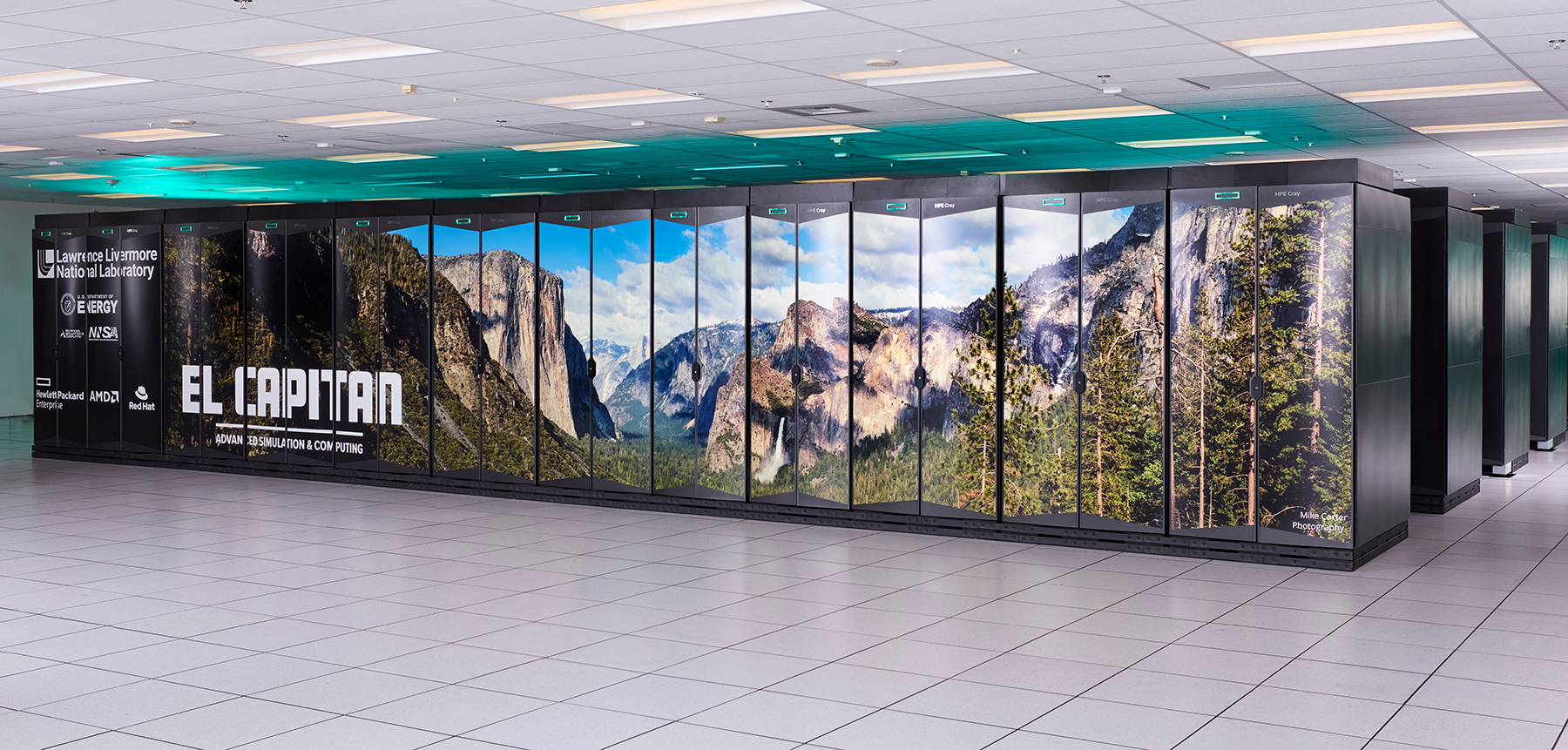
El Capitan, now the United States’ most powerful supercomputer, was brought online
in 2024. El Capitan is an ‘exascale’ computer—meaning that it can run one quintillion
(1,000,000,000,000,000,000+) calculations per second.
Photo Credit: Lawrence Livermore National Laboratory
That’s because even though our simulations don’t directly interact with the physical aspects of plant science, like growing and caring for seeds, soils and seedlings, doesn’t mean computational work has no barriers. It’s still about picking the right tool for the job at hand.
When working with a national supercomputing facility, data transfer is often bottlenecked for security and inspection purposes, or even just bandwidth limitations on the open internet. When we work with ICER, our data never goes outside the campus firewall, so transfer speeds are much, much faster.
Just like how physicists can request “beam time” at MSU’s own Facility for Rare Isotope Beams, we’ll ask for time on national supercomputing resources.
In the U.S., the supercomputers used in research are primarily built by federal agencies
like the Department of Energy and hosted at sites across the country. Getting access
to them involves a competitive allocation process. These programs, like the ACCESS program sponsored by National Science Foundation or DOE programs like the ALCC or INCITE, identify projects with the greatest potential to advance science and provide scientists
with a means of getting access to these powerful resources.
Similarly, ICER's HPCC is open to all researchers at MSU through a queue system.
ICER offers a robust array of support services they offer to help researchers, including
extensive documentation, one-on-one consultation services, office hours, a ticket
system and synchronous and asynchronous training webinars
Learn more at icer.msu.edu
- Categories: