Preparing future health professionals for an AI world
For the next generation of doctors, physician assistants and other health professionals, the question isn’t whether they’ll encounter artificial intelligence. It’s whether they’ll know how – and when – to use it.
That’s the idea behind HBIO 300, a new Michigan State University human biology course examining artificial intelligence in health care.
“Either our students are going to leave in a position to help make decisions about AI, or AI is going to just happen to them,” said Paul Nelson, an instructor in the Human Biology Program. “I think that’s the starting point.”
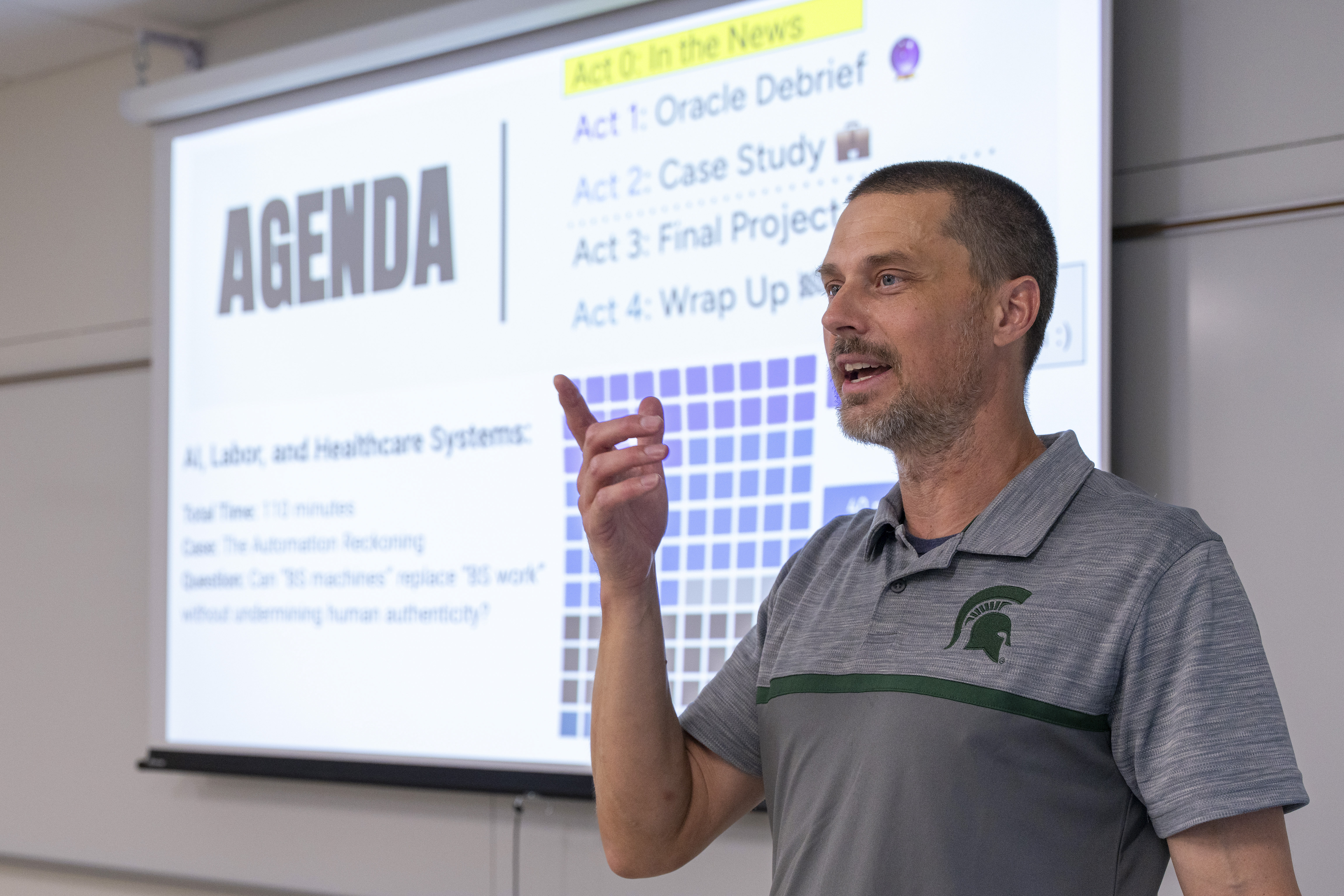
The course was offered for the first time last year in response to the rapid adoption globally of the technology. Now, the class is being expanded thanks to a recent AI-Ready Spartans grant. The cash infusion will make the class available to more students while also making connections with industry partners.
Rapidly expanding technology
While the use of AI is debated in many circles, health care is one area where its potential benefits are easy to imagine. Doctors and other health professionals are already using AI to synthesize patient histories, analyze medical images, write patient charts and create educational information tailored to a patient’s needs.
AI tools can also help medical students work through complicated cases, potentially giving more students access to the kind of diagnostic reasoning once learned primarily by watching experienced physicians.
But every potential benefit comes with questions.
What happens when AI gets a diagnosis wrong? Who is responsible? What if the diagnosis is right, but the physician can’t explain how the AI reached it? What happens to trust between patients and health professionals as more human interactions are handed over to technology?
The problem, Nelson said, is that AI is being adopted so quickly that society hasn’t had much time to consider the unintended consequences.
“As this is ramping up every day, students naturally have feelings and instincts about AI,” Nelson said. “I think what this class is doing is giving them a minute to slow down and listen, and to give us some shared vocabulary around the kinds of questions we should be asking ourselves.”
More ethics than computer science
In class, Nelson discusses the latest news in generative AI and offers students the floor to voice their feelings. Then, they turn to their case study – a fictional, AI-generated health care system with a wide cast of characters, including administrators, nurses, patients and physicians.
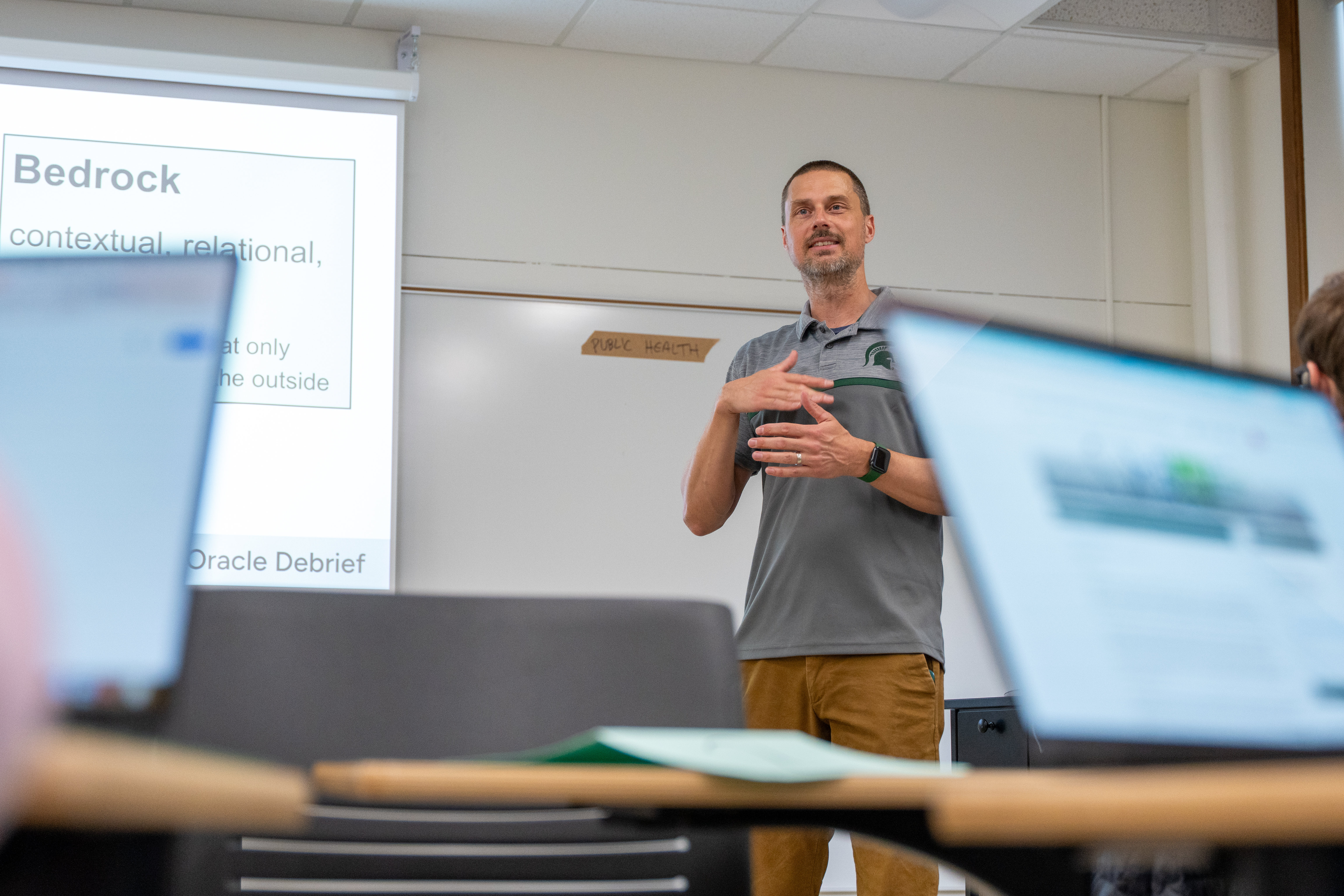
Throughout the semester, students follow the network through two fictional years as it encounters problems based on situations already emerging in the real world.
AI-generated patient education materials contain inaccurate information that leads to harm. Deepfakes undermine patients’ trust in doctors. Medical trainees become so reliant on AI that their own reasoning skills begin to suffer. An older patient becomes increasingly attached to a chatbot intended to help manage his care.
Each scenario forces students to consider the people affected by a technological decision, not just whether the technology works.
Students use their phones to share immediate thoughts in an online poll. Then, they’re split into groups to discuss topics like what’s lost when work is automated. Students point out that work will be allocated to more expensive employees, while the lower-paid employees lose their jobs.
The discussions continue outside class. Before some sessions, students take a position on a question related to that week’s topic. An AI-facilitated tool matches them with a classmate who disagrees, then guides them through a 20- to 30-minute conversation.
By the time they arrive in the next class, they’ve already had to defend their position and hear another perspective.
A healthy skepticism
The class isn’t pro-AI or anti-AI, and Nelson doesn’t tell students what they should think. Instead, students examine the same issue through different ethical perspectives.
For human biology major Megan Van Brunt, the class changed the way she thinks about AI.
Van Brunt, who plans to attend physician assistant school, had already seen health professionals use AI and expected medical applications to be different from the generative AI tools students encounter in everyday life. She imagined systems that would be highly accurate and capable of speeding up major medical advances.
Mental health changed her perspective. In class, she considered the promise of AI chatbots for people who can’t afford therapy or face long waits for care alongside the risks of people replacing human relationships with technology that may reinforce harmful thinking.
“It’s more accessible, but is it actually helping?” she said.
Mankirat Singh, a human biology student preparing for medical school, came to a similar realization after an exercise produced fabricated citations. AI could offer a quick summary of a scientific paper, but doing so also allowed students to skip the difficult work of learning how to read an abstract, interpret figures and understand an experimental design.
Those are skills health professionals develop through practice.
The class discussions have given students a place to wrestle with those trade-offs together. Rather than trying to win debates, students are encouraged to listen to opposing viewpoints and work toward policies or solutions that account for multiple ethical perspectives.
“You give your point, and then you get to hear someone else’s point, and you’re like, ‘I had never thought of that,’” Singh said. “That’s genuinely why I love this class.”
Having a say in what comes next
Nelson hopes HBIO 300 can eventually reach more human biology students, many of whom are preparing for careers in health care. The technology they encounter after graduation will almost certainly be more advanced than what exists today. The ethical questions may be harder, too.
No class can give them all the answers. Nelson would rather teach them how to ask the questions.
“I want them to feel like they have some agency about it, and it’s not just going to happen to them,” Nelson said. “This is giving them the tools they need to be able to talk about it and advocate for themselves or for other people who are being affected.”
- Categories: