Underwater sinkholes could reveal the Great Lakes’ hidden history
MSU researchers are searching for lake-bottom sediments to understand historic conditions, guiding Great Lakes restoration efforts
A story is hidden in the muddy floor of the Great Lakes.
The layers of rock, minerals and clay are the archives of North American history. They contain traces of the waters before major human impacts. Their chemical signatures reveal the drastic changes that occurred as agriculture, industry and cities transformed the region.
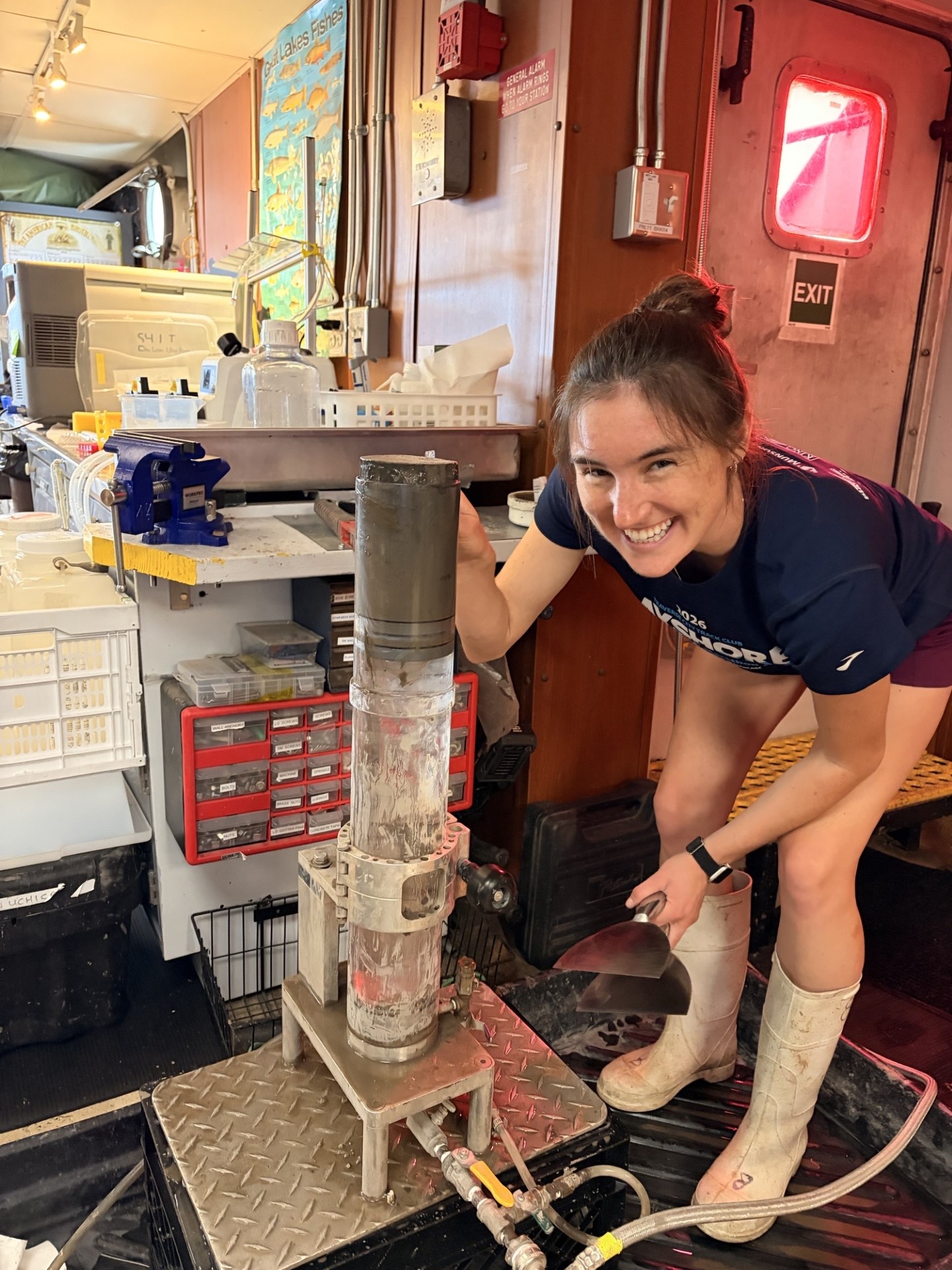
This summer, the Michigan State University Ph.D. student sailed from Milwaukee to Detroit collecting mud samples from newly discovered underwater sinkholes in Lake Michigan. Along with Dalton Hardisty, MSU associate professor of earth environmental sciences, she scooped up sediments that may help reveal whether these newly discovered sinkholes are preserving a record of the lakes’ past.
“Establishing those baseline conditions can give us a better target for recovery and what that should look like,” Kohler said.
In the grand scale of time, our Great Lakes are practically toddlers compared to the billions-year-old oceans. Carved by glaciers roughly 11,000 to 12,000 years ago, they continued shifting and changing for thousands of years. Their modern configuration was largely established about 4,000 years ago.
Human activity quickly intensified around the lakes. Farmers drained wetlands to create fields for crops, leaving lakes without their natural filter. They built canals that connected the Great Lakes to other watersheds, opening the door to stowaways like sea lampreys and other invasive species.
While studying the ocean floor can tell us about the prehistoric Earth, Great Lakes sediments provide a window into human history.
Searching for hidden archives
Kohler was awarded a one-year fellowship from the Cooperative Institute for Great Lakes Research, or CIGLR. To kick-start her research, she and Hardisty boarded the Lake Guardian in August, along with other researchers working on different projects, to cruise from Milwaukee to Detroit.
They used a crane to drop a huge, Mars Rover-like contraption into the lake equipped with four tubes like you’d find in a bank drive-through. Once on the lake floor, four tubes pushed into the sediment, collecting intact cores from the bottom.
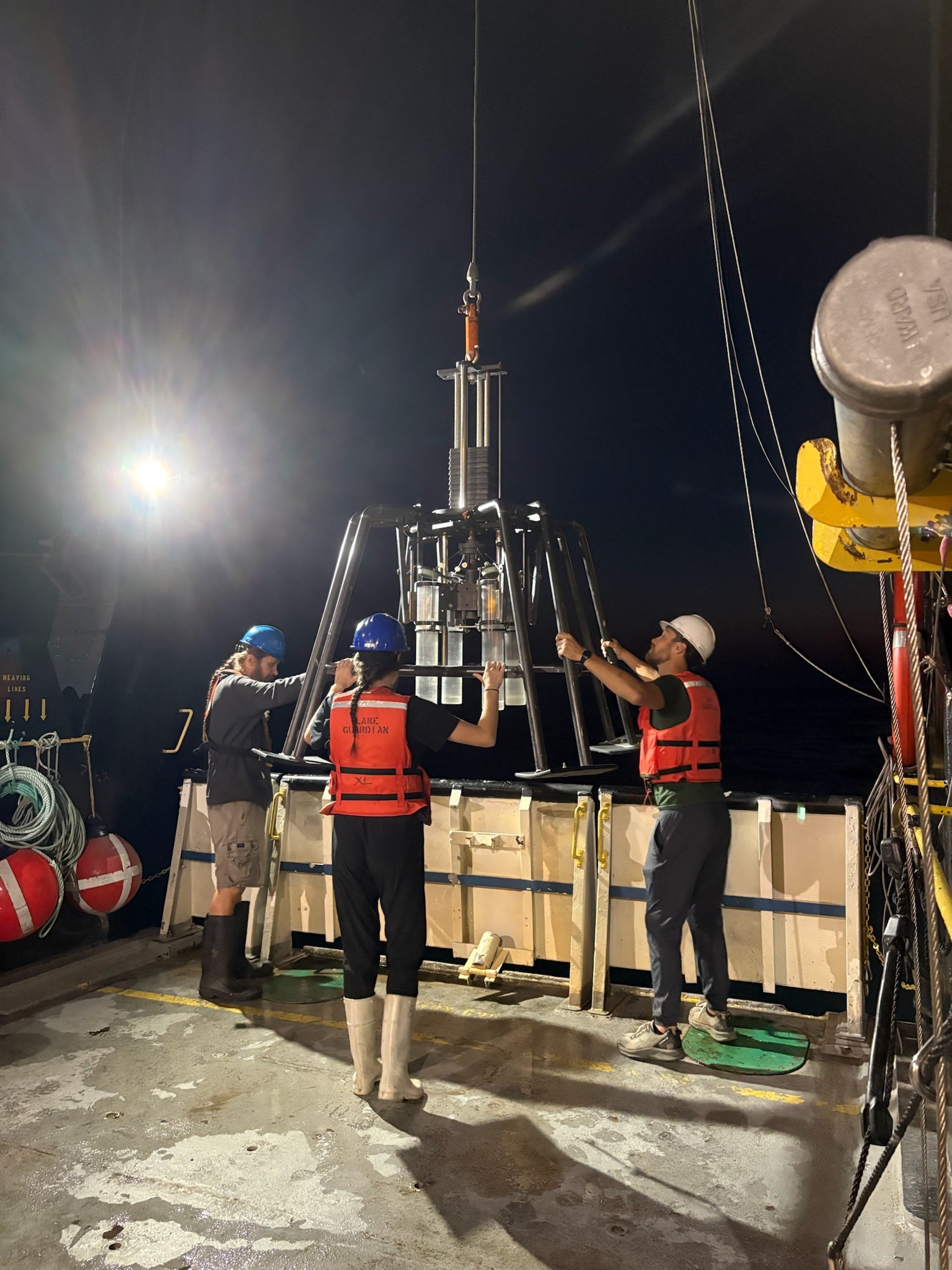
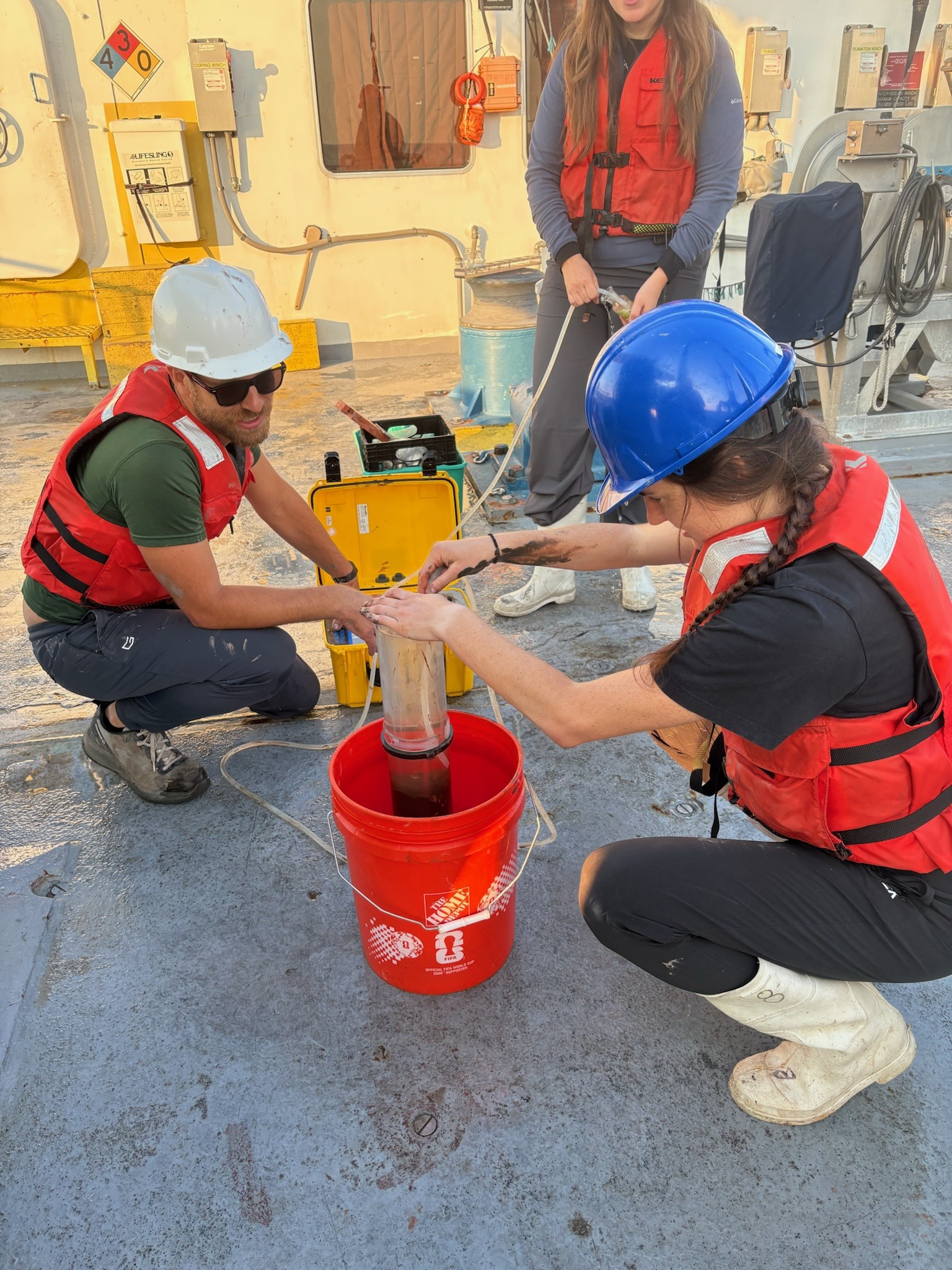
After the tubes are hauled onto the ship deck, Hardisty and Kohler get to work. They use a ship lab to process the cores for different kinds of analysis, extracting water from the sediment and preserving samples for later chemical and mineral studies.
“It’s dirty, but it’s fun,” Kohler said.
Kohler, a Ph.D. student in Hardisty’s lab, is focused on reconstructing the ancient conditions of the Great Lakes before Western colonization. Most of her research has centered on the Lake Huron sinkhole and other Lake Erie locations. The research cruise was like a scouting mission for other possible archives of ancient environments.
Because the Lake Michigan sinkholes have never been studied this way before, the cruise was in some ways a fishing expedition. Researchers used sonar to locate the depressions before maneuvering the ship precisely over features hidden hundreds of feet below.
What the sinkholes can tell us
The limestone at the bottom of the Great Lakes can behave almost like Swiss cheese. Groundwater slips through the cracks and holes, slowly dissolving the rock and carving out larger openings. Some sinkholes form when a cavern or weakened section of rock collapses under the weight of sediment above it.
If the groundwater is still flowing through the rock, it carries dissolved minerals and salts into the lake, making the groundwater denser than the surrounding fresh water. The two don’t mix easily, creating a low-oxygen environment.
These unusual conditions create environments where mats of microbes can thrive, and living things that would normally graze on them can’t live there without oxygen.
“It’s like a model for what the lake, or even ocean environments, might have been like before there was a lot of oxygen in the atmosphere or animals around,” Hardisty said.
Kohler wants to know if groundwater is still flowing through the limestone or, if not, when it would have last actively flowed. She’s also interested in the minerals that make up the sediment. If these sinkholes are low in oxygen, that could help preserve many minerals and organic materials that normally would decompose beyond recognition.
These organic materials have already been found in samples from Lake Huron. Hardisty’s question is, are conditions similar in other lakes? That matters because the preserved organic materials act as archives for the Great Lakes’ biogeochemistry, and how that changed through time.
Finding another place where the lake’s past is preserved could give scientists a better idea of what “healthy” means for the lakes. That matters for restoration. If the Great Lakes naturally experienced some low-oxygen conditions in the past, scientists wouldn’t want to set a recovery goal that assumes the lakes were once completely free of them.
Kohler will spend the next year of her fellowship analyzing the samples she collected on the ship and combing through the data. Piece by piece, she’ll reconstruct what the Great Lakes were like before major human impacts transformed their chemistry.
Each clue is another important chapter in the archives of North American history.
- Categories: