Bacterial partners shed light on the nervous system of Hawaiian bobtail squid
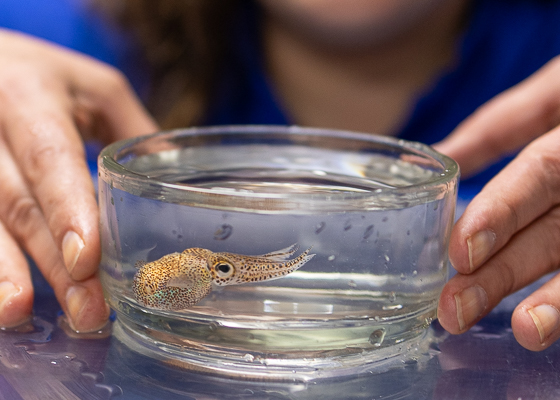
Every night, Hawaiian bobtail squid venture out to hunt with help from an unusual partner: bioluminescent bacteria that live inside their bodies and produce light.
The bacteria, Vibrio fischeri, live in a specialized structure called the light organ. Their light helps camouflage the small squid by matching light coming from above, obscuring the animal’s silhouette from predators below.
Scientists have studied this remarkable partnership for decades. Now, new research from Michigan State University’s Department of Microbiology, Genetics, & Immunology, or MGI, is providing a detailed look at a less-understood part of the relationship: the nervous system associated with the squid’s light organ.
In a study published in BMC Biology, researchers in the lab of MGI and Integrative Biology (IBIO) Assistant Professor Elizabeth Heath-Heckman found that the nervous system in the developing light organ is surprisingly complex. Their findings offer new insight into an aspect of the squid-bacteria relationship that has remained largely unexplored.
The work fills a gap in scientists’ understanding of the peripheral nervous system, the network of nerves outside the brain and spinal cord that connects the central nervous system with the rest of the body. It also creates a foundation for investigating the larger question of how bacterial partners interact with a host’s nervous system.

“Peripheral nervous systems are relatively understudied, but they’re also where a lot of communication between animals and their microbes takes place,” Heath-Heckman said. “We know bacteria can play an important role in how nervous systems develop, but we still have a lot to learn about how those interactions work.”
Looking inside the light organ
The relationship between E. scolopes and V. fischeri begins shortly after the squid hatch, when bacteria from the surrounding seawater colonize the light organ.
Previous research has shown that colonization triggers extensive developmental changes in the organ. It also produces changes in gene expression suggesting that neurons may be among the cells affected by the establishment of this symbiosis. Until now, however, the nervous system associated with the developing light organ had not been well characterized.
To better understand the developing nervous system, first author IBIO graduate student Alice Walker and undergraduate research assistant Elizabeth Widun examined the light organ in juvenile squid. They found that this network of nerves is considerably more complex than might be expected.

Two primary nerves are connected to one another within the light organ, while extensive networks of nerve fibers extend throughout it, including fibers associated with serotonin in areas that change as the bacterial partnership develops. The location of the connection between these two nerves suggests that the two sides of the light organ may“talk” to each other.
The team also found neurons within the light organ itself. They varied in shape and structure, and some were located near areas where the squid’s tissues interact with its bacterial partners.
"Connections across the midline are typically seen in the central nervous system,” said Walker, “so finding a structure connecting two nerve bundles after they've entered their target organ immediately struck me as unusual."
A new model for studying microbes and the nervous system
Scientists are increasingly discovering that microorganisms living in and on animals can affect their hosts in ways that extend well beyond digestion or protection from disease, including how animals develop and function neurologically.
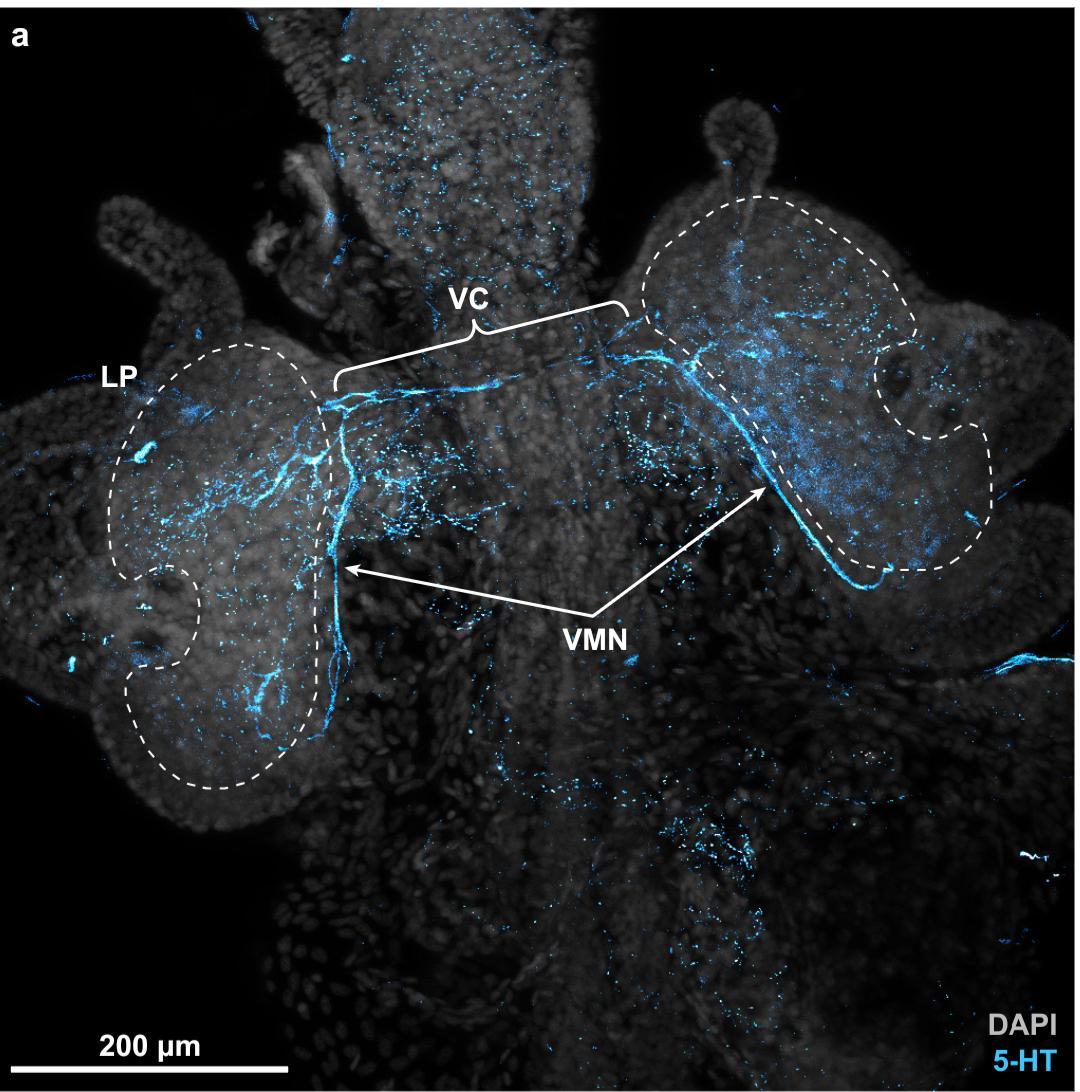
Two primary nerves, shown here in blue, can be seen in the light organ of the Hawaiian bobtail squid
Understanding exactly how those interactions work can be difficult, particularly in animals with large and complex microbial communities.
The Hawaiian bobtail squid offers researchers an advantage. Its light organ is colonized predominantly by a single bacterial partner, giving scientists a way to study communication between microbes and their animal host in a relatively simple biological system.
“Our little squid has been a great system for studying so many types of host-microbe interactions,” Heath-Heckman said. “It might also be a really good model for understanding how bacteria communicate with neurons and influence their development and behavior.”
The new study does not yet establish how V. fischeri affects the squid’s neurons and nerve fibers. Instead, by mapping their anatomy and identifying neurons and nerve fibers positioned near areas affected by bacterial colonization, the researchers have created a starting point for asking those questions.
The work also suggests that the nerves associated with the light organ have characteristics of a still-developing system, raising the possibility that they continue to change substantially after the squid hatches and its partnership with V. fischeri begins.
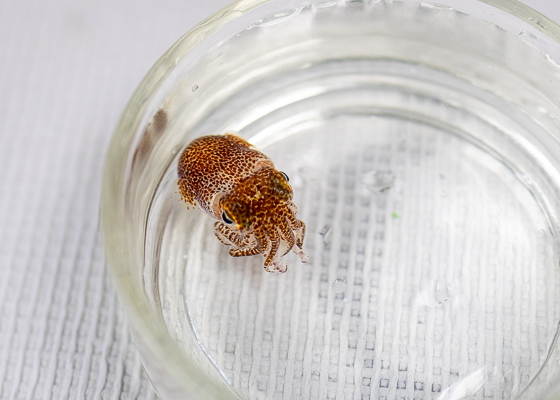
Bacterial partners shed light on the nervous system of Hawaiian bobtail squid.
Photo credit: Debbie Walton“We can now start looking at this relationship from both directions,” Heath-Heckman said. “We can ask how the nervous system influences the partnership with the bacteria, but also how the bacteria influence the nervous system. That opens up a lot of really exciting questions for us.”
For researchers interested in how microbes and nervous systems interact, that makes a tiny, glowing squid an especially intriguing animal to watch.
This research was supported by grants from the National Institutes of Health.
- Categories: