Small changes, big impact for bacteria used in environmental cleanup
MSU researchers find that the chemical makeup of bacterial growth media can change how some microorganisms respond to toxic metals.
Small changes in the chemistry surrounding Geobacter bacteria can have a surprisingly large effect on how the microorganisms interact with metals — a finding that could help improve their use in environmental cleanup, metal recovery and energy technologies.
New research from Michigan State University’s Department of Microbiology, Genetics, & Immunology, or MGI, shows that subtle differences in positively charged ions, known as cations, can change the outer structure of Geobacter cells and influence how the bacteria move electrons and transform metals. The work was published in Nature Communications.
Bacteria that interact with metals
Geobacter are electrically active bacteria with an unusual ability: Instead of relying on oxygen to accept electrons produced during metabolism, they can transfer those electrons outside their cells to metals and minerals. In the natural environment, Geobacter commonly interacts with iron and manganese oxides, but the bacteria can also interact with other metals, including uranium, which was the focus of this study.
Geobacter has multiple different ways of interacting with metals outside its cells. One involves extremely thin, conductive protein filaments called pili, sometimes described as “microbial nanowires.” These filaments allow the bacteria to transfer electrons to metals, changing their chemical form. In the case of uranium, this electron transfer converts dissolved uranium into solid mineral particles, a process called mineralization that helps prevent the contaminant from spreading through the environment.
A second method involves tiny, bubble-like packages called outer membrane vesicles.

“In our system, we think of vesicles as little packages that help the bacteria get rid of things they don't need,” said Morgen Clark, the paper's lead author and a recent MGI doctoral graduate. “One possibility is that they carry potentially harmful metals away from the cell.”
An unexpected discovery
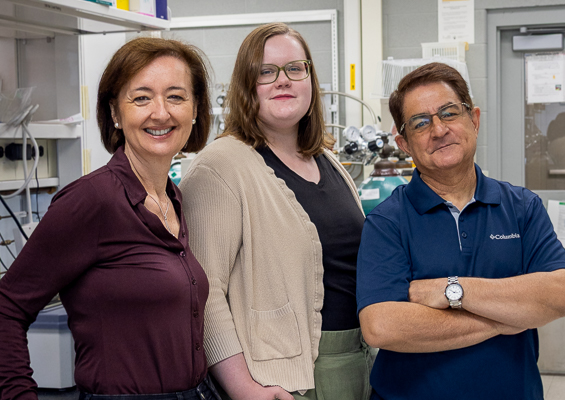
Clark and her colleagues, senior author MGI Professor Gemma Reguera and MGI Associate Professor Kazem Kashefi, originally set out to learn more about how Geobacter produces outer membrane vesicles. To investigate, the team grew the model organism Geobacter sulfurreducens in two commonly used growth media previously thought to be indistinguishable for laboratory studies.
The comparison led them to something they hadn’t been looking for. Although the two media were very similar, the vesiculation response from the bacteria was very different, prompting the researchers to investigate what was causing the change.
“We started out looking for the best conditions to characterize the vesicles themselves, and then we found this really interesting phenomenon where vesiculation was being affected by media that we thought were interchangeable,” Clark said. “I think that’s the beauty of a Ph.D. You get to pivot and follow the interesting questions you find.”
The researchers traced much of the difference to minor differences in the sodium content. One medium formulation contained slightly less sodium than the other, but it was enough to change the structure of the bacterial cell envelope and promote the release of outer membrane vesicles. But adding the sodium difference back to the lower-sodium medium reduced vesicle production, helping the team confirm that cation chemistry was driving the change.
“To our surprise, media formulations widely used across laboratories and considered
practically identical had big impacts on the cell envelope structure and functions
ultimately influencing mineralization outcomes,” Reguera said. “And sodium was not
the only cation modulating these cellular responses. Toxic metals such as uranium
triggered similar responses and controlled whether the cells vesiculated to detoxify
the radionuclide or assembled electrically conductive filaments as nanowires to bind
and zap uranium into a mineral to better protect the cell.”
These findings suggest that Geobacter, and potentially other bacteria, can adjust how it responds to toxic metals depending
on its surroundings. By sensing cations, Geobacter cells reprogram their envelope and whether they rely on their outer membrane vesicles
or on nanowires to remove the metal. Both mechanisms help protect the bacteria, but
changes in the surrounding chemistry can shift the balance between them.
From laboratory results to real-world applications

Laboratory media used to grow Geobacter are designed in part to recreate the mineral chemistry found at contaminated sites. The new findings suggest that researchers may need to pay closer attention to cation concentrations when comparing results across experiments and laboratories.
“Understanding the mechanisms behind these processes is essential if we want to generate reproducible results and use what we learn in the laboratory to improve bioremediation, bioelectrochemical technologies, and other applications,” Reguera said.
The discovery could also have implications beyond Geobacter. Because many other bacteria, including some human pathogens, share similar cell structures, the researchers want to determine whether small changes in their surrounding chemistry affect those bacteria in similar ways.
This research was supported by the U.S. Army Research Office and the National Science Foundation Emerging Frontiers in Research & Innovation program.