Physiology professor receives Mayo Clinic Early-Career Alumni Award
Erica Wehrwein, a professor in Michigan State University's Department of Physiology, has received The Mayo Clinic Early-Career Alumni Award in recognition of her contributions to physiology education and leadership in the field.
The award is especially meaningful to Wehrwein, whose postdoctoral training at Mayo Clinic helped shape her approach to understanding the body as an integrated system in health and disease. Today, she brings that perspective to her teaching at MSU and her work to strengthen physiology education nationally.
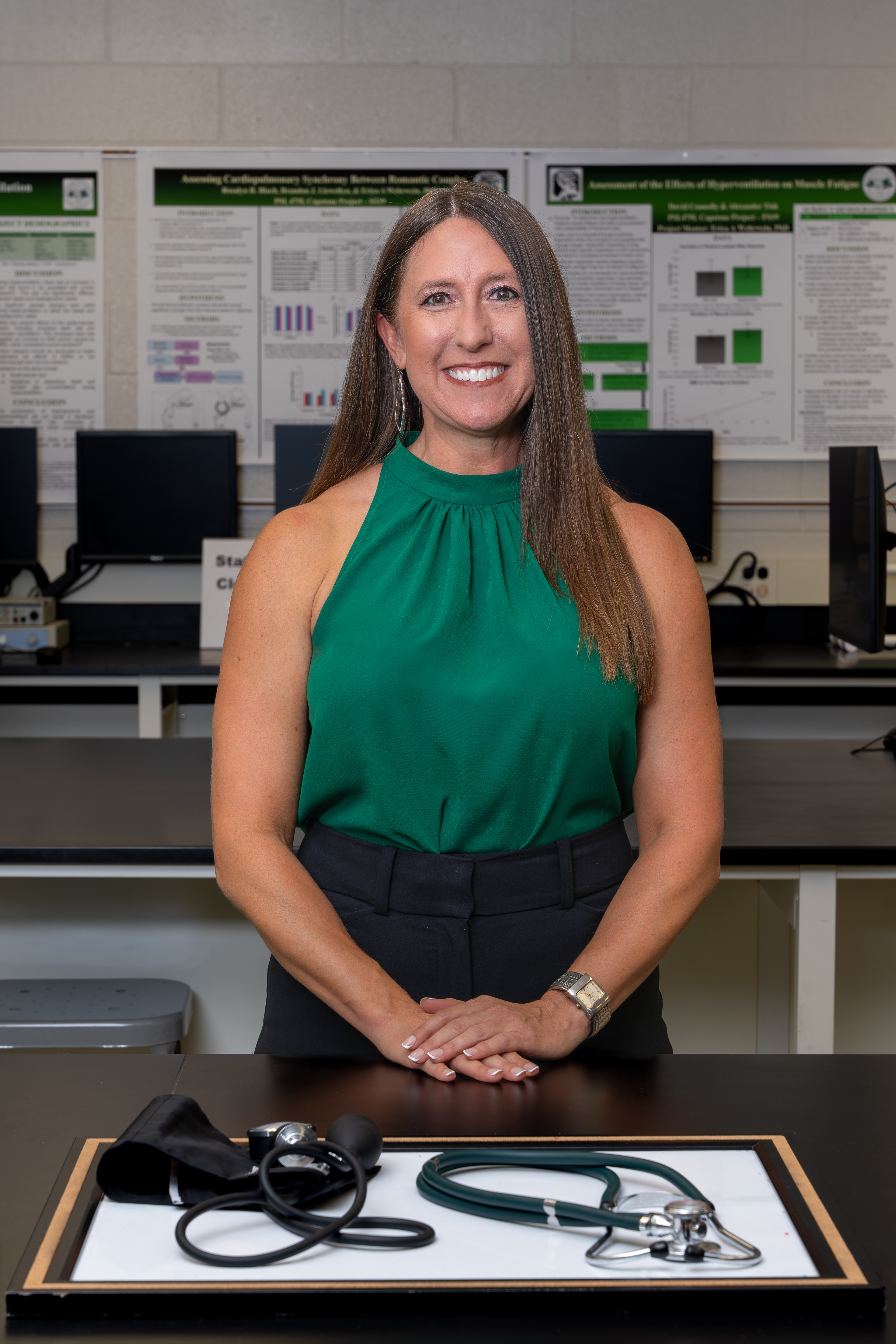
"It’s a tremendous honor to receive this recognition because of the respect I have for the clinic values, mission and people," Wehrwein said. "I am proud of my affiliation with the Mayo legacy and the outstanding mentors and colleagues there."
Wehrwein's work addresses a growing challenge across biomedical education: as scientific research becomes increasingly specialized, higher education institutions need faculty who can teach students how individual physiological systems work together in a complete human body.
In her paper published in Advances in Physiology Education, titled "Who Will Teach Physiology? The Growing Shortage of Physiology Generalists," Wehrwein details the national shortage of broadly trained physiology educators. She outlines strategies to prepare faculty who can connect laboratory discoveries to clinical care and bridge the gap between microscopic cellular mechanisms and whole-body function.
“We’ve become very successful at understanding the body in specialized and microscopic ways,” Wehrwein said. “Yet, it’s vitally important that we’re equally intentional about preparing people who can put those pieces together for meaningful application in medicine.”
Shaping the future through whole-systems education
At MSU, Wehrwein joined the faculty in 2011 and helped revitalize the required Physiology Capstone Laboratory for undergraduates. Drawing on her clinical research background in autonomic neural control and cardiovascular regulation, she developed a hands-on curriculum that forces students to think dynamically about how organs interact under physiological stress and disease states.
Rather than studying biological systems in isolation, Wehrwein’s approach requires students to observe how changes in one organ system ripple across the entire organism. This integrative methodology challenges undergraduates to shift away from memorizing isolated biological pathways and move toward diagnosing complex, multi-system interactions.
The experience reinforced her view that health science educators need both deep disciplinary knowledge and an understanding of how students learn systems thinking.
"The human body is a dynamic, integrated being," Wehrwein said. "Health and disease arise from the complex interactions of cells, tissues and organs, as well as the psychological, social and societal factors that shape our lives."
This integrative approach was heavily influenced by her postdoctoral mentor at Mayo Clinic, Michael Joyner, a professor of anesthesiology and perioperative medicine known for his landmark research in human integrative physiology.
"Erica is a gifted teacher, integrative thinker and question asker," Joyner said. "We live in a world where information is everywhere but insights are harder to come by. Her focus on integrative thinking helps students move beyond facts to connections."
By embedding these principles into the capstone course, Wehrwein ensures that future doctors, researchers, and healthcare professionals leave MSU with a fundamental framework for how whole systems operate together.
A dedicated commitment to student growth and mentorship
Beyond her contributions to curriculum design, Wehrwein’s day-to-day focus remains grounded in direct student mentorship. At MSU, her commitment extends beyond traditional lectures to helping undergraduates navigate academic choices, build professional identities and prepare for graduate or professional school entry.
Recognizing that many science majors struggle to articulate their skills to prospective employers or medical school admissions committees, Wehrwein incorporated explicit professional development into her laboratory courses. Students learn to translate their technical laboratory experiences into tangible competencies, developing resumes, practice interview skills and research portfolios alongside their physiological experiments.
Her mentorship also opens doors to active research. Wehrwein regularly guides undergraduate students through hypothesis-driven laboratory experiences, inquiry based learning, and independent study projects, encouraging them to design experiments, analyze complex human data and present their findings at university and national conferences.
For many students, working with Wehrwein marks their first opportunity to see themselves as contributing scientific researchers rather than passive learners. She emphasizes that scientific training is as much about learning how to ask actionable questions and manage failure as it is about mastering technical protocols.
"Mentorship is about recognizing the potential in students before they fully see it in themselves," Wehrwein said. "Our goal isn't just to help them pass a course; it's to equip them with the confidence, professional skills and critical thinking habits they need to thrive wherever their careers take them."
Building national networks for educators
Wehrwein’s leadership extends well beyond campus. Around 2012, she began working with colleagues across the country to gather data on undergraduate physiology programs and track employment outcomes for graduates.
That work led to the founding of the Physiology Majors Interest Group (P-MIG), a national grassroots community for faculty teaching undergraduate physiology. Under Wehrwein's leadership as co-founder and director, P-MIG helped establish national curriculum guidelines and benchmark standards for undergraduate physiology degrees.
Building on that foundation, she helped launch the American Physiological Society's Center for Physiology Education in 2022. The center provides curriculum frameworks, teaching resources and peer networks for faculty across undergraduate, graduate and medical programs. Wehrwein currently serves as chair of its advisory board.
Her national outreach efforts mirror her personal commitment to mentorship at MSU, where she continues to refine how educators support the next generation of healthcare professionals and scientists.
“I believe our greatest impact comes from what we make possible for others,” Wehrwein said. “The future of the physiology field depends on integrative, critical thinking—and that begins with how we support educators and our students.”