Grad students earn awards for national energy research
Three Michigan State University graduate students were selected for the Department of Energy’s Office of Science Graduate Student Research program. The award provides world-class training and access to state-of-the-art facilities at DOE national laboratories, preparing the next generation of scientists for roles of critical importance to the nation’s energy, science and national innovation priorities.
The Science Graduate Student Research, or SCGSR, program is highly competitive, selecting only 69 students from across 27 states in its most recent solicitation cycle. For MSU graduate students Ethan Fletcher, Bill Good and Brandon Kristy, the program supports their thesis research in collaboration with host scientists at U.S. National Laboratories.
Ethan Fletcher: Testing materials at the edge

Ethan Fletcher, a Ph.D. student at the Facility for Rare Isotope Beams, or FRIB, at MSU, focuses on the intersection of materials science and heavy-duty engineering. His research specialty is accelerator research and development, specifically looking at how materials behave when exposed to intense ion beams.
"At places like FRIB, beams of heavy ions are accelerated to high energies to produce rare isotopes for medicine and research," Fletcher said. "But those powerful beams also slowly damage the materials that guide, shape, stop, or transform them. My work helps ensure these complex facilities can operate more efficiently and reliably."
Fletcher’s research examines how materials respond to heavy ion beam exposure and how to design components that are more resilient in extreme environments.
His SCGSR award will take him to Fermi National Accelerator Laboratory, or Fermilab, where he will apply his modeling to large-scale accelerator operations.
"This award feels like a validation of the work and persistence it took to find the right research path," Fletcher said. "It gives me the chance to apply my work in an environment closely connected to large accelerator operations and learn experimental techniques I otherwise wouldn’t have access to."
For Fletcher, the goal is to bridge the gap between fundamental science and practical impact.
"National laboratories are places where those two things often come together," Fletcher said. "The collaborations I build at Fermilab will carry far beyond my dissertation."
Bill Good: Peering into protons
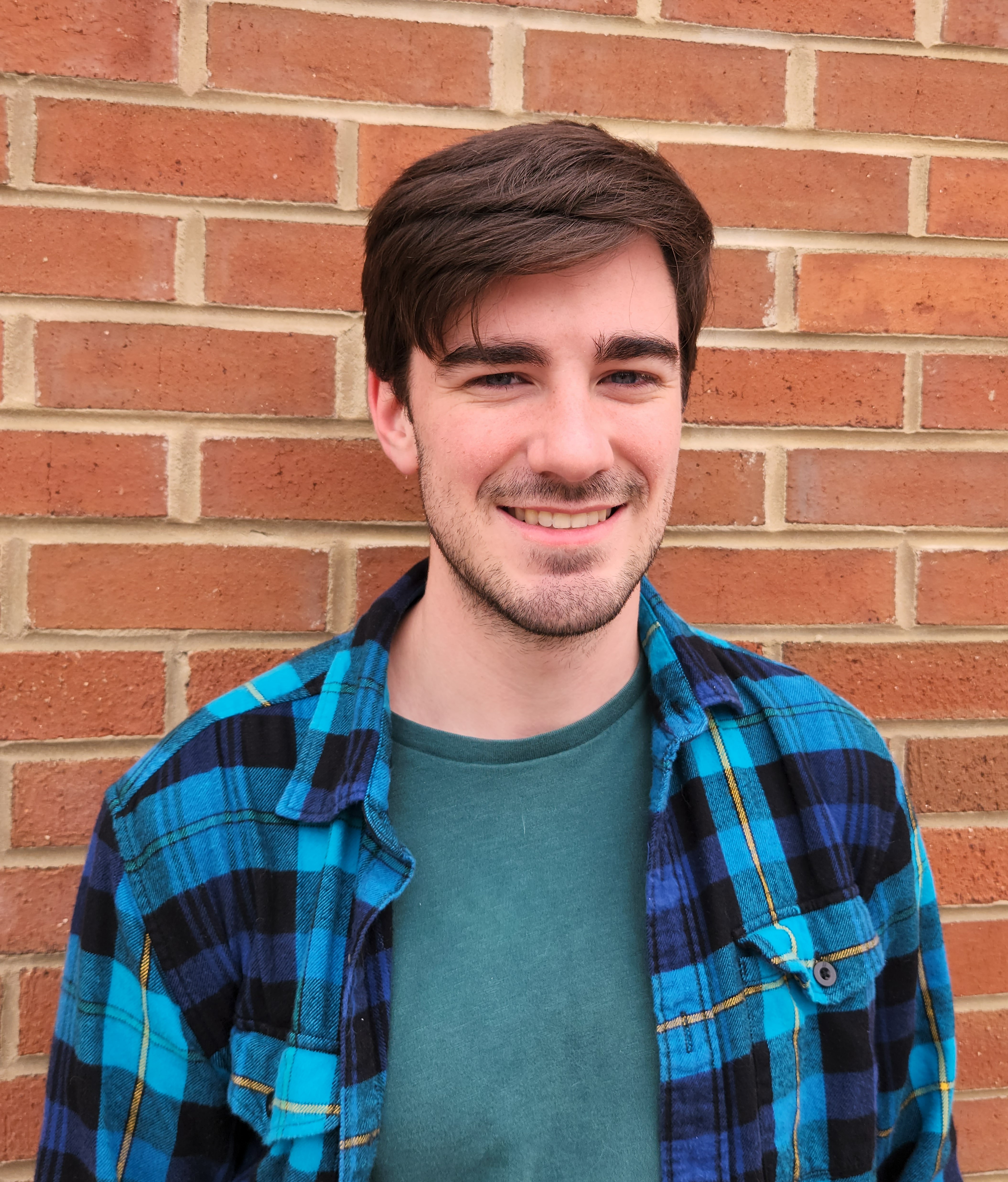
Bill Good, a first-year Ph.D. student in physics and astronomy, will conduct research at Argonne National Laboratory, or ANL, with MSU professor Huey-Wen Lin’s lattice quantum chromodynamics, or QCD, group, studying the fundamental structure of protons.
"QCD is the study of the force that holds quarks together to form protons and neutrons," Good said. "Gluons are the particles that carry this force, but they are extremely difficult to study because they hide between quarks. I study how gluons behave inside of protons, which is fundamental to our understanding of how protons get their mass and spin."
The research is highly collaborative. While theoretical physics is often pictured as a solitary endeavor, Good said the reality is much more social. The SCGSR award allows him to work directly with Dr. Yong Zhao at ANL, a scientist who developed a new technique for calculating gluon distributions that were previously too "noisy" to simulate accurately.
"New ideas rarely spawn in seclusion," Good said. "This award is about connecting graduate students with scientists and learning new skills. My favorite part is meeting new people and making new collaborators along the way."
For Good, who hopes to one day become a professor, the work is about answering fundamental questions. "I’m not sure Benjamin Franklin imagined the light bulb when he tied a key to a kite in a thunderstorm," Good said. "I can’t imagine what technology may come from what we are learning now, but it is important to understand what the universe is made of, since we are a part of it."
Brandon Kristy: Harnessing soil microbes
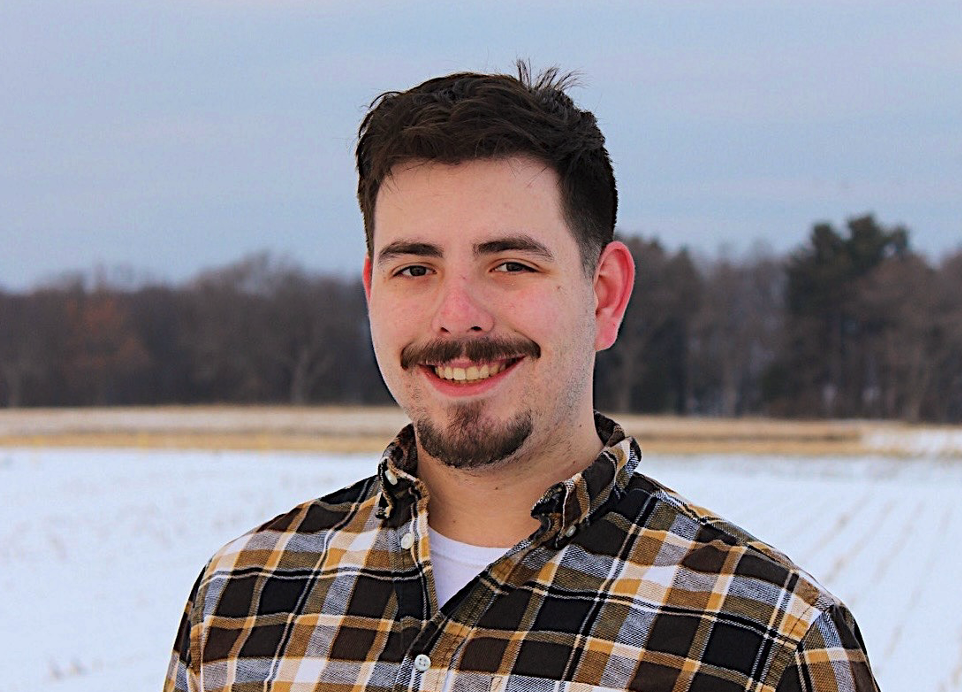
Brandon Kristy, a Ph.D. student in the Department of Integrative Biology and a member of the Evans Lab at the Kellogg Biological Station, will go to Lawrence Livermore National Laboratory, or LLNL, to study the "unseen" partners of sustainable bioenergy.
Kristy’s specialty is plant science for sustainable bioenergy, where he investigates how soil microbiomes can help crops like switchgrass thrive without relying on excessive chemical fertilizers.
"Bioenergy crops are a major solution to climate change, but managing them can result in fertilizer waste and runoff," Kristy said. "Amazingly, microbes in the soil can make their own fertilizer. I am interested in exploring how plant-symbiotic fungi can team up with nitrogen-fixing bacteria to provide more nitrogen to these crops naturally."
At LLNL, Kristy will use cutting-edge nanoscale ion mass spectrometry to visualize isotopic signatures inside roots and fungi. This high-resolution imaging will allow him to measure the exact nutrient exchange between plants and their microbial teams.
Kristy’s journey was fueled by the Department of Energy, or DOE, ecosystem. After an undergraduate internship at Oak Ridge National Laboratory, he joined the Great Lakes Bioenergy Research Center at MSU.
"DOE programs have been pivotal to my career development and growth as a scientist," Kristy said. “The cutting-edge tools at LLNL will significantly increase the scope and impact of my dissertation.”
Like his colleagues at FRIB and Argonne, Kristy’s work underscores how MSU graduate students are leveraging national resources to turn fundamental scientific inquiry into real-world solutions.
- Categories: