From Brunei to MSU, student uses data science to help the planet
For Badri Aiman Khan, data has always been more than numbers on a screen. It’s a way to uncover hidden patterns, understand complex systems and tell stories that might otherwise go unnoticed.
A data science major in Michigan State University’s College of Natural Science, Khan first fell in love with statistics long before arriving on campus. He was fascinated by how trends and relationships between variables could reveal deeper truths about the world.
“I find it very fulfilling to move beyond surface-level observations and use data to understand the deeper causes behind real-world issues,” Khan said.
That mindset followed him from Bandar Seri Begawan, the capital city of Brunei, to East Lansing. Growing up in a rainforest nation, he spent years volunteering in beach and river cleanups and tree-planting initiatives. Environmental stewardship felt personal, something rooted in daily life.
When Khan enrolled in the course Integrative Studies in Biology through MSU’s general education curriculum, he did so intentionally. Though not required for his major, the course offered an opportunity to better understand environmental systems beyond the lens of data alone. What he did not expect was how directly the class would connect to his academic path.
From Classroom Assignment to Research Recognition
As part of a project called Integrating Non-Science Perspectives into Responsive Engagement, or INSPIRE, Khan’s group was tasked with creating a documentary on the environmental and social harms of fast fashion.
“I didn’t realize how large of an issue it truly was,” Khan said. “As I began researching, I discovered how complex it is, including its connections to carbon emissions, labor conditions and global supply chains.”
As the team’s data specialist, Khan worked with international datasets, including World Bank indicators and industry-level environmental data, to quantify trends in textile production growth, emissions and labor inequities.
“There is a large amount of information available, but identifying the factors that best illustrate the relationships between environmental impact, production growth and industry behavior required careful consideration,” Khan said.
He cleaned and organized the datasets, compared multi-year trends and built visualizations that translated complex numerical relationships into accessible graphs for the film. One of the project’s most striking findings came from a machine learning model he developed to estimate projected carbon dioxide emissions from textile companies. Even as fast fashion companies introduced sustainability pledges, the model projected emissions continuing to rise — highlighting a stark gap between corporate commitments and measurable outcomes.
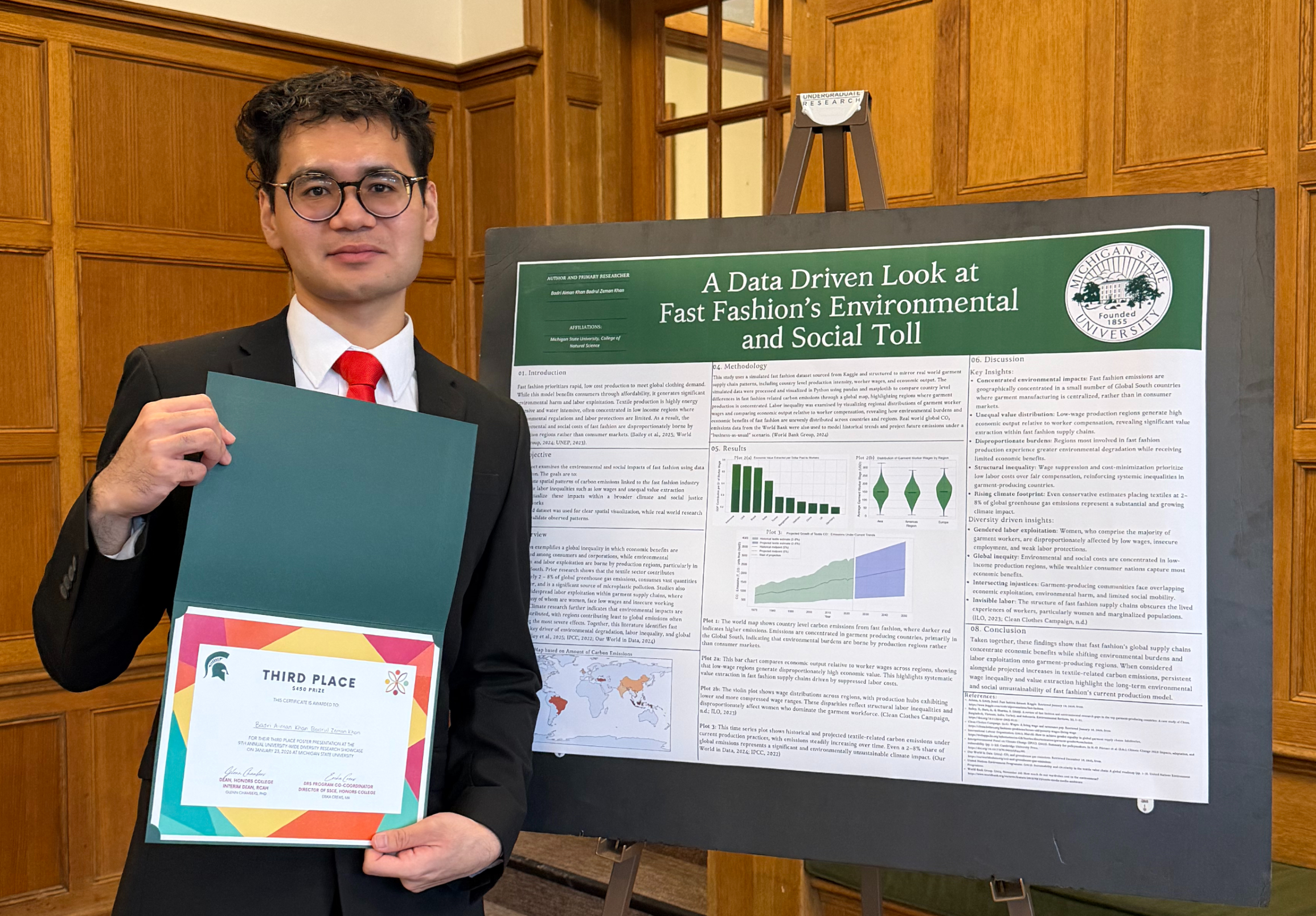
Encouraged by Saroopa Taylor, assistant professor in the Center for Integrative Studies in General Science, Khan expanded the work into a research poster and presented it at the university’s Diversity Research Showcase, where he received third place in the poster presentations. The recognition validated not only his analysis, but also his voice as a researcher.
“I was genuinely surprised,” Khan said. “Receiving the award made me realize that this topic is truly worth researching further.”
A Global Perspective in Data Science
As one of only three students from Brunei currently on campus, the award-winning moment carried added meaning for Khan. Sharing his research, and earning recognition for it, felt like representation as much as achievement.
“In a way, it feels like I’m helping represent Brunei and put it on the map within the university community,” Khan said.
His decision to attend MSU was shaped by the university’s global community and commitment to diversity. Adjusting to life in Michigan meant rebuilding a support system from scratch and adapting to new academic and cultural environments. But the experience strengthened his independence and reinforced his sense of purpose.
At MSU, Khan has increasingly applied data science to environmental sustainability, workers’ rights and social equity. The interdisciplinary foundation provided through the College of Natural Science has shown him how technical skills can intersect with global challenges.
After graduation, he hopes to pursue a career that combines data science with environmental and social impact, using evidence to inform policy and uncover overlooked problems.
“I’ve learned that impactful research doesn’t always begin in a laboratory,” Khan said. “Sometimes, it begins in a classroom, with an interest, a dataset and a willingness to ask deeper questions.”
And sometimes, that interest can carry a student from Brunei to the research stage at Michigan State University — transforming numbers into stories that matter.
- Categories: