Moving past the mouse – genetic advances inspire new frontiers
Recent epic leaps in genetics have created a biodiversity library. As the genetic make-up of animals, plants, fungi, bacteria, and viruses has been mapped, researchers racing to develop solutions to today’s global challenges run into a question: Why be limited to a mouse?
Fish, bears, birds, snakes, water fleas, and carnivorous plants are among the many new stages on which discovery is unfolding. The challenge is to refine the theater to optimize performance.
In a recent Nature Review Biodiversity, Michigan State University evolutionary biologist Jason Gallant pressed a case for research – from classrooms and laboratories to funding agencies and patent offices – to take full advantage of a supersized research toolbox.
Conventional research models, most notably mice, frogs, zebrafish, flies, roundworms, and yeast, were go-to models. Their genetic makeup was best understood, they were easy to keep in a laboratory, and scientific communities rallied around them with support and powerful databases. While successes have been robust, more than 80% of potential therapeutics developed via mouse models fail when tested in people. And neither mice nor fruit flies offer tempting pathways to answer questions about environmental or changing climate.
“We have been given amazing tools and opportunities to tailor research models to specific questions,” Gallant said. “These exciting developments mean we have to do things differently – how we train scientists so they can be faster and smarter as they look for discoveries and inventions.”
The nervous system of an octopus may hold answers to controlling prosthetic limbs, and sea sponges have already pointed to life-saving drugs. Birds’ rapid adaptations harbor lessons in coping mechanisms. Bacteria have shown an appetite to “eat” plastic to help clean up oceans.
Relying predominantly on traditional models, Gallant argues, overlooks enormous biological innovation that can be found among the roughly 8.7 million species estimated to be alive today: life has evolved innovations—disease resistance, novel metabolic pathways, unique symbioses— that can offer solutions to urgent problems.
“So many exciting doors have been opened,” Gallant said. “It would be unconscionable not to stride through them to a new future.”
Already at Michigan State University and universities across the country, scientists exploring biodiversity and its potential are creating supportive channels, notably in organizations under the umbrella of ecology and evolution.
“The crowdsourcing of support and wisdom is invaluable in science,” said Professor Elise Zipkin, director of MSU’s Ecology, Evolution, and Behavior graduate program. “Creating multi-disciplinary groups is a great start, but to truly advance discovery and strengthen educating the next generation of scientists, it is crucial that specific investments in infrastructure be made."
Gallant’s Electric Fish Lab explores nervous-system proteins by studying weakly electric fish. He has colleagues across the East Lansing campus with an unconventional army of plants, animals, and microbes. They have ‘bottled evolution’ by studying bacteria. Devised innovative solutions to invasive species using lamprey pheromones. Identified how rough-skinned newts produce potent neurotoxins without poisoning themselves.
MSU’s strength and breadth in novel models is international leadership that dovetails well into MSU’s new One Team, One Health initiative. That effort organizes faculty around shared thematic research priorities and aligns research strategies more closely with our clinical and community partners while better supporting faculty in pursuing and successfully securing federal program grants and funding.
In labs across campus, and in scientific publications from these labs, advances in ways to examine and manipulate genetic material, harness big data to understand evolutionary change, and creative ways to link the natural world with human health abound.
It's time, Gallant and his colleagues argue, for science to shift with the seismic changes – starting with the silos that often physically separate researchers into different buildings, academic pathways, and different funding streams. A researcher today who chooses to explore with an unconventional model often wrestles with figuring out how to keep the models thriving and affordable. MSU EEB, with its unique expertise in developing new models, takes the lead and provides the proverbial village to raise new research organisms.
“We don’t need to leave the mouse behind,” Gallant said. “We just need to invite the rest of life into the lab.”
Among the examples of MSU’s leadership exploring unconventional models:

Electric Fish
Specifically, weakly electric fish that live in the freshwater rivers of Ghana. These aren’t the electric fish that sting – those known as eels or rays. Rather, they have evolved a biological battery to emit low-level electrical pulses for communication and navigation.
Gallant’s MSU Electric Fish Lab explores how these fish have, over generations, created genes that control the cells that have rewired these muscles. It’s a question that also has tantalizing questions about what the dynamic talent of these fish means to human health.
A few years ago, Gallant learned of a heart condition that runs in his family, one that led to discussions about research studies to find markers of the disease. But those findings led to yet more questions.
“In studies, you find these marker variants and then have no idea how to interpret them,” he said, “especially with excitable cells like muscles and nervous systems. We know mutations occur, but then it gets difficult to understand them.”
Biological models – be they mammals like humans, or cold-blooded critters, fish, insects, or plants - are important to studies of human diseases or conditions because you can test these models in ways you can’t with people. In Gallant’s world, it’s significant that heart muscles rely on electric impulses. (Think about how doctors “shock” a heart in distress.)
Conducting basic research by zapping a muscle or cell in a person isn’t possible – but electric fish, Gallant notes, are swimming excitable cells. “We can start to fill the knowledge gaps about one of the key functions in our bodies in an easy way that you can’t do in humans.”

Carnivorous Plants
Tropical plants that behave both like complex, contained communities and a lot like human guts can be exciting labs, according to MSU plant biologist Kadeem Gilbert.
Gilbert, an assistant professor of plant biology at MSU’s Kellogg Biological Station, and his
students study pitcher plants such as those native to the tropical jungles of the Philippines. The plants have modified leaves that form pitfall traps, a deep cavity filled with digestive juices.
These cavities aren’t just a last stop for unsuspecting insects, and even bigger creatures like rodents, lizards, and frogs. Gilbert said they also house entire communities of symbiotic arthropods – like bugs, spiders, and crustaceans - and microbes.
“Pitcher plants have been an exceptionally useful model system for community ecology, helping to answer questions about how biological communities assemble, how species coexist within communities, and many other fundamental questions about the maintenance of biodiversity,” he said.
Gilbert sees a pathway to answering questions about human health, too. Pitcher plant species can regulate the pH levels in their pitchers, allowing a plant to influence the structure and function of its microbiome. It’s a brilliant trick in which they transport enzymes and protons to create digestive acid – a mechanism the plants share with human stomachs. The plants also share some bacteria found in human guts.
That, in Gilbert’s eyes, fills pitcher plants with promise to fill some critical knowledge gaps about how pH levels and microbiomes interact. It’s a high-stakes puzzle since human diseases like gastric reflux disorder alter the pH environment, leading to breakdowns of the healthy microbiome. Treating those conditions with proton pump inhibitor drugs also alters gut pH leading to a proliferation of potentially harmful microbes.
“There are practical and ethical limitations on the types of manipulative experiments that can be conducted on humans,” he said. “There are no such limitations with plants. In a plant we can apply proton pump inhibitors and directly monitor changes in pH over time in a much less invasive way than sticking an endoscope down someone's throat.

Brown Bears and Venomous Snakes
Brown bears and venomous snakes may seem to have little in common, and maybe even less with people. But both have unique adaptations that may help us learn more about our own biology at a molecular level.
Blair Perry, an assistant professor of integrative biology, works with non-traditional models to understand how unique and extreme adaptations arise in nature. Those questions are compelling. Consider what we can learn from a brown bear.
They go into hibernation every winter after gaining massive amounts of fat in the fall. They live off that fat for up to six months while staying largely inactive and not eating. During hibernation, bears’ body temperature and heart rate decreases and their metabolism slows down considerably. Bears even become insulin resistant during this time, a hallmark of pre-diabetes in humans. Yet brown bears emerge every spring healthy and do not develop Type II diabetes or experience harmful consequences of extreme obesity and prolonged inactivity.
The magic of hibernation is believed to be a complex interaction driven by the regulation of thousands of genes across multiple tissues. Many of these genes are shared across mammals and vertebrates more broadly and underly basic biological functions, like metabolizing nutrients and handling cellular stress. Bears, it seems, have evolved unique ways to change the activity of these genes during hibernation. Research in the Perry Lab seeks to understand how changes in the regulation of these shared genes led to the evolution of hibernation.
“Understanding how bears are using essentially the same genes and cellular processes present across mammals, including humans, to achieve these extreme physiological feats without developing disease or dysfunction may provide new insight into ways to prevent and treat diabetes and other metabolic diseases in humans,” he said. “The more we understand the extremes of biology, the better we can understand our own biology and how we fit into the diversity of life on Earth.”
Venomous snakes, in contrast, have evolved a set of unique and specialized genes that produce the various toxin proteins that make up venom. Perry’s research seeks to understand how these venom genes evolved, and how they contribute to differences in venom between different populations and species of venomous snakes.
“This work aims to better understand big picture rules of genome biology, gene regulation, and evolution that are applicable to a diversity of systems, including humans, Perry said. “A better understanding of the genomic basis of snake venom variation in nature may bolster efforts to develop and improve treatments for snake bite, a neglected tropical disease.”
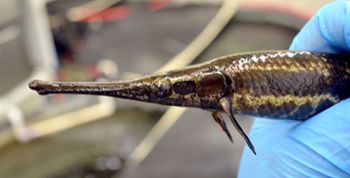
Fishes
Ingo Braasch is calling for a “new model army” - of fish.
Gills, scales, fins, and that whole surviving-on-land challenge don’t slow him down. Braasch, an associate professor of integrative biology, sees advances in understanding genetics as opening the floodgates to fish as pathways for research, particularly biomedical research.
He’s happy to count the ways. Recently he published with EEB PhD student member Hao Yuan and colleagues a Perspective article in Nature Methods outlining state-of-the-art methods for computationally transferring knowledge across species such as from fish to human. It’s a call to equip that fish model army with ways to unlock a treasure trove of data.
And, he argues, trove it could be. Fish may neither look nor live like us, but some favored biomedical fish models, like zebrafish, share about 70 percent of their genes with us.
“Many aspects of their body plans and development from egg to embryo and adult - and even some behaviors - are actually pretty similar,” Braasch said. “Researchers can model a plethora of human disease conditions in the zebrafish and many other fish species. The list is actually very long and growing.”
Braasch is developing the spotted gar as a model in his Fish EvoDevoGeno Lab at MSU. These are known as “living fossils” because they are ancient-looking, have evolved slowly and “can tell us a lot about our own history and the evolutionary origins of human traits and diseases.”
Among the advantages of fishes as models:
- Fishes are relatively easy and cheap to keep with a relatively small facility footprint. Costs are much lower than, for example, for rodent facilities.
- They give rise to dozens to hundreds or thousands of eggs per spawn, depending on species, giving experiments strong statistical power.
- Research-friendly reproduction. Fertilization in fish is usually external, so the mother needn’t be opened or sacrificed to get to early developmental stages like in mice and other mammals. Embryos are often transparent, allowing for high-resolution imaging of internal organs.
- Unique regenerative abilities. For example, even as adults, they can regenerate their fins (a model for limb loss), large parts of their brain (a stroke model) and peripheral nervous system, parts of the heart (a model for heart attacks), retina, and more.
“The genes that fishes use in these regenerative processes typically do also exist in human, so researchers have learned a lot from fishes about how gene networks could potentially be tweaked so that these regenerative capabilities are revived in humans.”
He also noted current research suggests that mammals lost old capabilities to regenerate, rather than it being an innovation of fishes.
“The genomic revolution lets us sequence any fish species in a fast and cheap way to generate high quality genome assemblies,” Braasch said. “This has opened a tsunami of genomic information for old and new fish model species.”
Daphnia (water fleas)
As a researcher, Nina Wale loves transparency. It’s what has made her give her scientist’s heart to the common water flea.
The fleas, known as Daphnia, are literally transparent, one of the qualities she says makes them terrific models for understanding the dynamics of infection. Mice have long been serving models of infectious disease, and she still turns to them as she strives to understand how pathogens evolve. But, she notes, fur can really get in the way.
Wale, an assistant professor in microbiology, genetics, and immunology, and in
integrative biology, has sweeping questions about pathogens – both at the scale of
their effect on the individual, and also at the scale of epidemics.
Those questions demand models that allow full transparency,
“Daphnia are clear – their bodies get filled up with parasites and you can see them and monitor them easily,” Wale said. “That’s hard to do on a mouse – they have fur so you can’t just look inside a mouse.”
Water fleas, she said, also allow manipulation of entire populations. They’re inbred – meaning their offspring are identical to the parents, and they quickly produce a lot of generations. Since they don’t fly, those families are conveniently grouped in easily accessible Michigan ponds that can be rehomed in the laboratory.
She’s also interested in what she says us one of the oldest responses to parasites across the tree of life – an organism withholding food to try to kill the invader.
“Key to implementing such interventions is basically understanding foods the host and the parasites fight over,” she said. “Key groups of foods that pathogens fight over are trace metals – iron, zinc, and sometimes copper. Hosts have developed amazing ways of keeping these metals from getting to pathogens. And, on the flip side, pathogens have countered by evolving elaborate mechanisms to "steal" them from their hosts.”
She said it’s hard to watch that high-stakes microscopic battle in mouse models. But she’s deploying MSU’s ultrasensitive metal-quantification tools (inductively coupled plasma mass spectrometry), which can quantify metals at minuscule concentrations, to track where nutrients go in infected Daphnia and who – host or parasite – ultimately gets to use them.
“It’s an extreme example of what goes on in every infection,” she said. “It’s always a battle for food, and I’ll bet my hat that in Daphnia we can watch that battle.”
Read Biologists should embrace Earth’s biodiversity as a library of solutions in Nature Reviews - Biodiversity.
- Categories: